
Fund Breakdown: Axis Greater China Equity FoF
This fund gives access to three markets - China, Taiwan, Hong Kong and is still trading at a fraction of what US tech commands.
What kind of fund is this?
Axis Greater China Equity Fund of Fund is a fund of fund, meaning it doesn't invest directly in Chinese stocks. Instead, it invests in the Schroder International Selection Fund Greater China, an offshore fund managed by Schroders, one of the world's largest active asset managers with deep, on-the-ground China expertise.
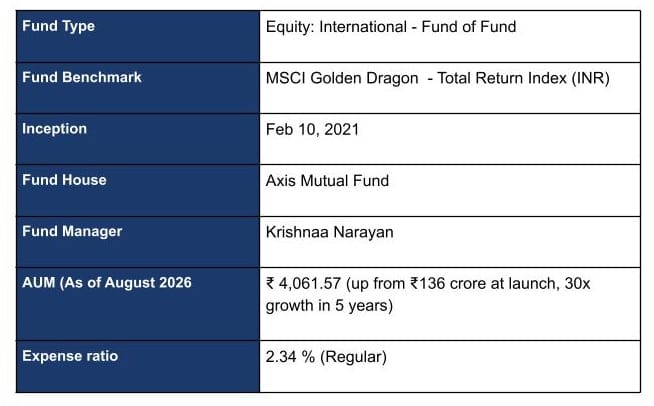
Here is why we find this fund genuinely interesting right now.
The Manager: Why Schroders on China specifically
Schroders is not a generic global fund house doing China from a distance. Their Asia Pacific equity team comprises 59 fund managers and analysts conducting more than 2,600 company visits per year across the region. They have had investment offices in Hong Kong since 1971, Shanghai since 1994, and Beijing since 1976.
The Greater China equity team specifically is headed by Louisa Lo and comprises 20 members drawn from the broader Asia Pacific team. Total Greater China AUM managed by Schroders: approximately US$15 billion.
This is a team that has been on the ground in mainland China and Hong Kong for five decades, through cultural revolutions, Tiananmen, the handover, SARS, the 2008 global crisis, the 2015 circuit breaker crash, COVID, and the 2021 regulatory crackdown.
When Schroders makes a call on a Chinese company, it comes from 50 years of institutional memory and active local presence. That is meaningful context when you're investing in a market as policy-sensitive and information-asymmetric as China.
What the Fund owns
The underlying Schroder ISF Greater China portfolio as of August 2026:
Top 10 Holdings:
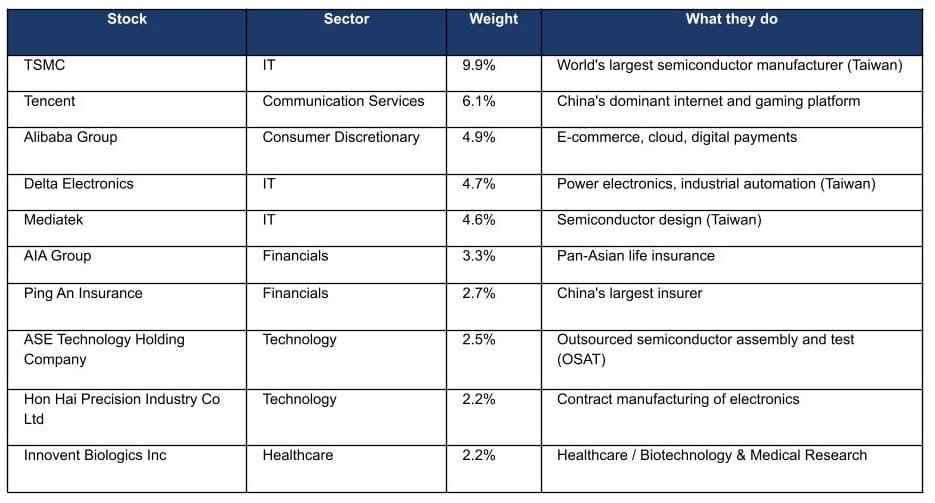
- Returns are annualized. Data as of Aug 30, 2026. Past performance is not an indicator of future returns.
Three things stand out in this portfolio:
First, this is Greater China, not just mainland China.
TSMC at 9.9% is the world's most important semiconductor company and it is Taiwanese. Mediatek is also Taiwanese. AIA is Hong Kong-domiciled.
The fund captures the full Greater China ecosystem; mainland China growth, Taiwan's technology hardware dominance, Hong Kong's financial infrastructure. This is broader and more diversified than a pure mainland China play.
Second, the active management is genuinely active.
TSMC is underweighted by 66% versus the index despite being the largest holding at 9.9%.
This tells you the index wants even more TSMC than Schroders is willing to give it.
The manager is making a deliberate call to hold TSMC at below-index weight while overweighting Tencent and AIA. These are high-conviction active bets and not merely passive index replication.
Third, Delta Electronics and Mediatek as a significant active overweight is interesting.
Delta Electronics and Mediatek are the two largest active bets versus the index. This is a deliberate view that automation and Semiconductor companies, offer better risk-adjusted return than the index weight would suggest. It's a call that distinguishes the portfolio from any passive China vehicle.
The Bear case named honestly
China is not a smooth ride. This fund can drop 10-15% on a single geopolitical headline, a Taiwan tension flare-up, a new US tariff announcement, or a domestic regulatory action.
China's structural challenges such as an aging population, property sector drag, weak consumer confidence, are genuine and will not resolve quickly.
We are not dismissing these risks. Any honest assessment of China must begin here.
The question the VBA Framework asks is not whether there risks? There are always risks in every market. The question is: are these risks adequately priced into current valuations?
The Bull case: Five reasons the risk may be priced in
Schroders' own summary observations from their presentation make the case:
1. The economy is structurally into AI and industrial automation.
China is investing aggressively in robotics, AI infrastructure, and advanced manufacturing. This is already appearing in earnings.
2. Chinese manufacturing is moving up the value chain.
The era of cheap Chinese labour doing low-margin assembly is giving way to higher-value manufacturing; electric vehicles, batteries, solar panels, advanced electronics. BYD is not building cheap cars. CATL is not making cheap batteries. These are globally competitive, technologically sophisticated businesses.
3. China is a global leader in specific technologies: robotics, AI, telecom.
Huawei's 5G infrastructure, DJI's drone dominance, Chinese AI models competing with US equivalents. In several technology categories, China is already at the frontier.
4. Extreme valuation divergence is itself a reason to invest
Chinese equities trade at P/E ratios of approximately 8-9x, roughly half the valuation of Indian equities and less than half of US equities. This gap is one of the widest in modern market history. Either Chinese businesses are fundamentally and permanently worse than their global peers. or the valuation gap will partially close. History suggests the latter.
5. Global investors are currently underweight China, creating significant potential inflow.
After the 2021 regulatory crackdown and the COVID zero-policy period, most global institutional investors dramatically reduced their China allocation. Many are still underweight relative to China's share of global GDP and market capitalisation. If confidence returns, driven by stimulus working, geopolitical tension easing, or simply valuation becoming too compelling to ignore, the re-entry of global capital could be significant and rapid.
One additional data point from the slides that is underappreciated:
China now contributes 50% of all innovative drugs newly entering global clinical stages as of 2025 YTD. China’s identity is no longer about cheap manufacturing. This is a China producing globally relevant intellectual property in one of the world's most competitive industries.
Let’s see how the fund has performed as of Sept 25, 2026
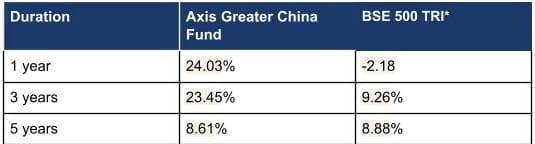
- Returns are calculated since inception with daily rolling frequency for the 1, 3 and 5 years period. Data as of Sept 25, 2026. Past performance is not an indicator of future returns.
The Expense Ratio and why it is worth it
The total expense ratio for the regular plan is 2.34% higher than most domestic equity funds, and worth understanding before you invest.
The 2.34% covers two layers: the Axis FOF wrapper (1.59%) and the underlying Schroder ISF Greater China fund's own charges. On the surface, 2.34% sounds steep. But here is what that cost is actually replacing, and why Finamily thinks it makes sense.
If you tried to invest directly in Chinese or Taiwanese stocks as an Indian investor, you would face three significant frictions that most people never account for.
First forex conversion charges. Every rupee that moves into a foreign-denominated account comes with conversion costs.
Second, dividend distribution tax. When you receive dividends the source country takes its share through withholding tax. The rules differ depending on the country. In China, Taiwan and Hong Kong the tax treatment is not the same.
Third, tax reporting and compliance. Holding foreign equities brings paperwork.
You may need to file FEMA disclosures. In some cases FATCA requirements apply. These tasks take time and effort. You need a specialist to handle them properly.. That means ongoing costs.
All of these factors make foreign investing more complex than it seems. Each step has its hidden cost.
The fund route eliminates all three frictions entirely. The forex conversions, dividend taxation and compliance burden all happen at the fund level.
The VBA Framework view
China sits in our Dirt Cheap bucket, P/E 8.8x against a historical median of 11.4x.
That 22% discount to historical fair value is the mathematical expression of every risk we named above being priced in. The market is not ignoring these risks. It is pricing them aggressively.
At Finamily, our approach is not to predict whether China's structural challenges resolve in 2027 or 2030. Our approach is to identify when the price of a market has fallen far enough below intrinsic value that the margin of safety is compelling and deploy capital systematically, not in one shot.
China at P/E 8.8x is that situation.
Though the fund had closed for fresh subscriptions in May 2026, the window can open up again. If you want to take the opportunity of this market through an actively managed portfolio that is genuinely different from the index, the Axis Greater China FOF can give you access through a specialist manager with 50 years of on-the-ground China experience.
Who this Fund is for
✅ Investors who already have a diversified core India portfolio and are looking to add meaningful international exposure
✅ Those who understand the VBA Framework and want to act on China's Dirt Cheap signal in a managed, specialist vehicle
✅ Long-term investors with 3-5+ year horizon who can hold through China's structural adjustment period without panicking
✅ Those who want active management rather than passive index exposure to China, the Schroder team's 50-year on-the-ground presence is a genuine differentiator
Who should avoid
❌ Investors with less than 3 years horizon, the tax structure and China's volatility both work against shorter holding periods
❌ Anyone with a low risk appetite. The fund can be volatile during geopolitical flare-ups: Taiwan risk, US-China tensions, or regulatory crackdowns can move this fund 20-30% in a short span.
❌ Those with no core India portfolio already in place, international allocations are satellites, not starting points
❌ Investors who cannot distinguish between China's structural problems (real, acknowledged, known) and its valuation (already pricing those problems in)
Final verdict
The case for this fund is not that China is without problems. It clearly has serious, structural, long-duration challenges; demographics, debt, property, geopolitics.
The case is that all of those problems are visible, widely discussed, and priced into a market trading at P/E 8.8x, the cheapest it has been in over a decade.
What is less priced in, because markets are forward-looking and China's forward story is genuinely uncertain, is the possibility that China's industrial transformation into AI, advanced manufacturing, and biotechnology produces earnings growth that the current multiple does not anticipate.
Schroders gives you the right team to navigate this: 50 years on the ground, 20 dedicated Greater China analysts, 2,600 company visits per year, and an active portfolio that makes deliberate bets beyond what a passive index would give you.
At Finamily, this fund earns its place in client portfolios as a deliberate, sized, satellite allocation to the highest-conviction international opportunity we currently see alongside our recommended domestic India Large Cap core.
Suggested allocation: 8-12% of total equity portfolio as a dedicated China satellite. Deployed via STP over 4-6 months rather than lumpsum. A minimum of 3-year commitment. Reviewed annually against VBA zone assessment.
If you want to know when the subscriptions to this fund will open up again or whether this fund is right for your portfolio, reach out for a 1:1 call.
Sources used for this edition
Axis Greater China Equity Fund of Fund fact sheets; World PE ratio, Screener, Moneycontrol, MSCI. Figures were pulled from public sources across August-Sept 2026. Always cross-check against the current factsheet before acting on anything here.
Published for educational purposes only. This is not investment advice, not a research report under SEBI's RA regulations, and contains no buy/sell/hold recommendation. These are insights on a publicly available mutual fund, meant to help readers to understand the fund relevance to their portfolio. Data as of Sept 25, 2026 unless dated otherwise, always verify against the latest Finamily factsheet before relying on any number here.
JOIN MY NEWSLETTER

Hi! I'm Avinash
Welcome to my blog. This is a collection of real case studies from my clients that helps you understand how to solve investment problems and approach financial goals.

Created with © Avinash Baskar | AMFI-registered Mutual Fund Distributor ARN-264201