How a couple went from drowning in debt to their first emergency fund
A couple came to me two years ago carrying something heavier than debt.
They were educated, employed, earning reasonably well. And completely underwater on personal loans and credit card dues, all high-interest, all compounding, all getting worse every month.
The obvious question was: how do we restructure this debt?
But before we got there, I noticed something. Every single month, their expenses exceeded their income. Not by a fixed amount. By a different amount each month, for a different reason.
January: flight tickets for parents visiting.
February: child's medical expense.
March: a birthday celebration.
April: a trip that started as a weekend getaway.
The pattern kept repeating.
The root cause nobody was talking about
When I sat with them and traced each overspend back to its origin, something unexpected emerged.
Almost every expense had started with a search.
The child's first birthday was coming up.
They searched for ideas. Within hours, the algorithm had shown them decorator packages, personalised return gifts, theme setups, outfit combinations, photoshoot options.
What began as a simple celebration became a production, because every touchpoint they encountered raised the bar of what a good first birthday looked like.
The trip followed the same pattern. A simple break from the city. A few searches. Suddenly they were looking at Vietnam itineraries with water parks and resort stays and the budget had moved from ₹30,000 to ₹1.5 lakhs before they had booked a single thing.
The aspirations were growing because of what the algorithm was showing them.
What we did: in three stages
Stage 1: Stop the tap
Before any debt restructuring, before any investment plan, before any budgeting framework, we stopped the credit card.
Not reduced usage. Stopped it entirely.
This took six months. Not because it was technically difficult, but because the credit card had become the invisible infrastructure of how they lived. The moment it was gone, a whole behaviour of buy now and pay later decisions simply disappeared. They couldn't impulse-spend what they didn't have access to.
Stage 2: Restructure the existing debt
With no new debt being added, we turned to what existed.
First, we retired the most expensive obligations, the personal loans and credit card balances carrying high interest. Second, where high-interest debt could be swapped for lower-cost borrowing, we used gold loans as a bridge. The effective interest rate dropped significantly. The monthly cash flow pressure reduced.
Stage 3: Build the income-expense architecture
This was the structural change that made everything else sustainable.
Two separate bank accounts: one for income, one for expenses.
At the start of every month, a fixed amount was transferred to the expense account. Investments were taken out first, before any discretionary spending. Whatever remained in the expense account was the month's budget, when it was gone, it was gone.
There was no calculation required in the moment. No willpower test every time they wanted to spend. The architecture decided for them. They could only spend what was in the account.
Every month we reviewed where the expenses had gone, category by category, line by line. Not to judge. To see. Because most overspending is invisible until you name it.
Where they are now two years later
The aspirations haven't disappeared. The Instagram habit hasn't been fully broken; they still browse, they still see, they still want things beyond their current income.
But the funding mechanism is gone. And the architecture doesn't bend.
The result after two years:
Credit card usage: completely stopped
High-interest personal debt: significantly reduced, swapped to lower-cost obligations
Emergency fund: built from zero to a meaningful base — their first financial cushion in years
Investment habit: small but consistent, taken out at the start of every month before anything else
They are not wealthy yet. But they are on footing they have never stood on before.
The Finamily Takeaway
I want to be honest about what this case study is and isn't.
This is not a story about which mutual fund to buy. There is no VBA Framework allocation here. There is no compounding calculation.
This is a story about behaviour.
About the invisible ways the digital environment we live in continuously inflates what we think we need. About how a credit card makes that inflation painless right up until it isn't. And about how changing the architecture of your finances, not just your intentions, is what actually produces different behaviour.
The income-expense review we did every month wasn't a lecture. It was a mirror. Most people have never looked at their spending broken down and named, category by category. When they do, the pattern becomes visible. And visible patterns can be changed.
The most important financial decision this couple made wasn't about an investment. It was about a bank account.
If you recognise your own pattern in this story- overspending that feels justified in the moment, debt that grows for different reasons every month, a gap between what you earn and what you feel you need- that conversation is exactly what Finamily is here for.
VBA STATE OF PLAY - SEPTEMBER 2026
The framework compares current valuations (P/E ratios) against long-term historical medians to identify where value and margin of safety reside.
To know more about what is the VBA Framework→ Read the full explainer here
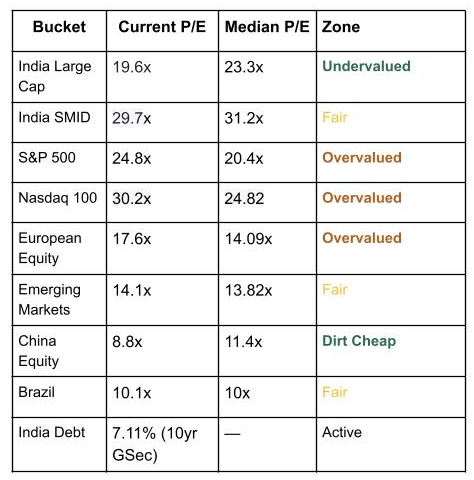
Allocation Flow — Where fresh capital goes this month
China (Dirt Cheap) → India Large Cap (Fair — one index fund) → India Debt (Short Duration — goal-based) →Emerging Markets (Fair) → Brazil (Fair) →India SMID (Fair)→European Equity (Fair)→S&P 500 / Nasdaq →(Overvalued)
Note: The VBA Framework allocates based on current valuations. It does not predict where markets are going. This newsletter is for educational purposes only and does not constitute investment advice. Mutual fund and equity investments are subject to market risks.
FUND BREAKDOWN
Axis Greater China Equity Fund of Fund Regular Growth
The Axis Greater China Fund of Fund gives you access to China, Taiwan, and Hong Kong's best businesses through a manager who has been on the ground since 1996.
One fund. Three markets. A valuation story that is hard to ignore.
References
Axis Greater China Equity Fund fact sheets; World PE ratio, Screener, Groww, MSCI. Figures were pulled from public sources across Aug-Sept 2026. Always cross-check against the current factsheet before acting on anything here.
Published for educational purposes only. This is not investment advice, not a research report under SEBI's RA regulations, and contains no buy/sell/hold recommendation. These are insights on a publicly available mutual fund, meant to help readers to understand the fund relevance to their portfolio. Data as of Sep 25 2026 unless dated otherwise, always verify against the latest factsheet before relying on any number here.
This is not a buy or sell recommendation. This newsletter is for educational and informational purposes only. Investing in single-country emerging market funds carries significant risk, including the risk of substantial capital loss. Please read all scheme-related documents carefully. Past performance is not indicative of future returns. The VBA Framework allocates based on current valuations and does not predict market direction.
JOIN MY NEWSLETTER
Hi! I'm Avinash
Welcome to my blog. This is a collection of real case studies from my clients that helps you understand how to solve investment problems and approach financial goals.

Created with © Avinash Baskar | AMFI-registered Mutual Fund Distributor ARN-264201